—— 要投稿,上万维,轻松学术交流

严正声明

本站非期刊官网,非中介代理,
不向作者收取任何费用!
举报微信:13140028228 冯老师

态度公正、信息求实、投稿自助、使用免费
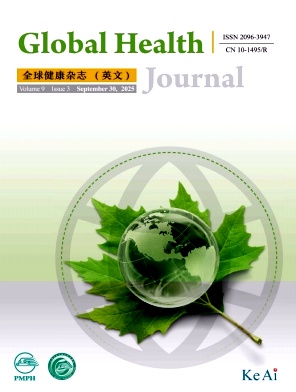
全球健康杂志(英文)(Global Health Journal)
CN外文 - 季刊
  • 全球健康杂志(英文)(Global Health Journal)
  • 复合影响因子:0.231
  • 国级普刊
  • 知网,万方,维普
  •  
  投稿方式:官网投稿
  • 栏目频次
  • 一作占比
  • 单位占比
  • 热词
暂无栏目信息.
暂无一作信息.
暂无单位信息.
暂无关键词信息.
  • 更多

    期刊简介

  • 《全球健康杂志(英文)》(Global Health Journal)(季刊),创刊于2017年,由国家卫生健康委员会主管,人民卫生出版社有限公司主办并出版的医学专业学术期刊。期刊以深入全面地探讨全球健康的主要挑战、应对全球健康管理,并引领全球健康在观念和制度方面的创新为办刊宗旨。

  • 基本信息

  • 期刊名称:全球健康杂志(英文)(Global Health Journal)
  • 主管单位:国家卫生健康委员会
  • 主办单位:人民卫生出版社有限公司
  • 国内刊号:CN 10-1495/R
  • 国际刊号:ISSN 2096-3947;EISSN 2414-6447
  • 出刊日期:
    期刊定价:
  • 邮发代码:
  • 所在省区:北京
    邮政编码:
  • 联系地址:

  • 投稿信息

  • 学科分类:预防医学|卫生学
    版面费用:待核实
  • 字数要求:6000-16000
    查重要求:-
  • 复合因子:0.231
    综合因子:0.123
  • 审  稿 费:待核实
    稿费:待核实
  • 本刊可发:
  • 特殊属性:外文期刊

  • 联系方式

  • 投稿网址:https://www.editorialmanager.com/glohj
  • 官网网址:http://www.keaipublishing.com/cn/journals/global-health-journal/
  • 电话传真:010-59787183(202503期)
  • 电子邮箱:ghj@pmph.com(202503期)
  • 微信公众号:全球健康杂志英文版(GHJ-PMPH)

审稿时间:暂无参考数据,审稿时间不确定!

投稿难度:网友分享,仅供参考

见刊周期:-

温馨提示以上只是参考信息,实际情况会根据投稿主题、稿件质量和数量、审稿流程有所差异。想获得更准确信息请联系期刊的编辑部进行咨询。

欢迎点评!让信息更透明,使投稿更轻松!
    • 审稿时间:
      是否录用:
    • 发表排期:
      查重要求:
    • 有无课题:
      有无回复:
    • 我的学历:
      我的职称:
    • 审稿费用:
      版面费用:
    • 稿       费:
      稿件字数:
    • 投稿难度:
    • 该刊可发:
    • 投稿主题:
匿名: 验证码: 点击切换验证码
    • 1、投稿方式:在线投稿。

      2、刊内网址(202503期):

      http://www.keaipublishing.com/cn/journals/global-health-journal/

      https://www.editorialmanager.com/glohj(投稿)

      3、刊内电话:010-59787183

      4、刊内邮箱:ghj@pmph.com

      5、出刊日期:季刊,逢季末月30日出版。

      6、官方微信公众号:全球健康杂志英文版(GHJ-PMPH)

      2026年1月9日星期五

      《全球健康杂志(英文)》投稿指南

      【官网信息】

      Guide for Authors

      Introduction

      Types of paper

      Contributions

      falling into the following categories will be considered for

      publication: [ research articles, reviews, health policy, short

      communications,editorials, commentaries, letters, perspectives, window

      for China, bridging Belt and Road countries ].

      Please

      ensure that you select the appropriate article type from the list of

      options when making your submission. Authors contributing to special

      issues should ensure that they select the special issue article type

      from this list.

      Before you begin

      Before You Begin

      For

      information on Ethics in Publishing and Ethical guidelines for journal

      publication see https://www.elsevier.com/publishingethics and

      https://www.elsevier.com/ethicalguidelines

      Ethics in publishing

      Please see our information pages on Ethics in publishing and Ethical guidelines for journal publication.

      Submissions

      to KeAi journals are automatically screened using iThenticate's

      CrossCheck within the editorial system to detect plagiarism issues

      including instances of overlapping and similar text in submitted

      manuscripts. Details can be found here. High similarity papers will be

      desk rejected.

      Ethics approval and consent to participate

      Manuscripts reporting studies involving human participants, human data or human tissue must:

      include a statement on ethics approval and consent (even where the need for approval was waived)

      include the name of the ethics committee that approved the study and the committee's reference number if appropriate

      All

      materials must adhere to high ethical and animal welfare standards. Any

      use of animals must be based on ethological knowledge and respect for

      species-specific requirements for health and well-being. A statement

      indicating that the protocol and procedures employed were ethically

      reviewed and approved, and the name of the body giving approval, must be

      included in the Methods section of the manuscript.

      Consent for publication

      If

      your research or manuscript contains any individual person's data in

      any form (including any individual details, images or videos), consent

      for publication must be obtained from that person, or in the case of

      children, their parent or legal guardian. All presentations of case

      reports must have consent for publication.

      Studies in humans and animals

      If

      the work involves the use of human subjects, the author should ensure

      that the work described has been carried out in accordance with The Code

      of Ethics of the World Medical Association (Declaration of Helsinki)

      for experiments involving humans. The manuscript should be in line with

      the Recommendations for the Conduct, Reporting, Editing and Publication

      of Scholarly Work in Medical Journals and aim for the inclusion of

      representative human populations (sex, age and ethnicity) as per those

      recommendations. The terms sex and gender should be used correctly.

      The

      author should ensure that the manuscript contains a statement that all

      procedures were performed in compliance with relevant laws and

      institutional guidelines and have been approved by the appropriate

      institutional committee(s). This statement should contain the date and

      reference number of the ethical approval(s) obtained. Authors should

      also include a statement in the manuscript that informed consent was

      obtained for experimentation with human subjects. The privacy rights of

      human subjects must always be observed.

      The

      journal will not accept manuscripts that contain data derived from

      unethically sourced organs or tissue, including from executed prisoners

      or prisoners of conscience, consistent with recommendations by Global

      Rights Compliance on Mitigating Human Rights Risks in Transplantation

      Medicine. For all studies that use human organs or tissues authors must

      provide sufficient evidence that they were procured in line with WHO

      Guiding Principles on Human Cell, Tissue and Organ Transplantation. The

      source of the organs or tissues used in clinical research must be

      transparent and traceable. Authors of manuscripts describing organ

      transplantation must additionally declare within the manuscript:

      that autonomous consent free from coercion was obtained from the donor(s) or their next of kin; and

      that organs/tissues were not sourced from executed prisoners or prisoners of conscience.

      All

      animal experiments should comply with the ARRIVE guidelines and should

      be carried out in accordance with the U.K. Animals (Scientific

      Procedures) Act, 1986 and associated guidelines, EU Directive 2010/63/EU

      for animal experiments, or the National Research Council's Guide for

      the Care and Use of Laboratory Animals and the authors should clearly

      indicate in the manuscript that such guidelines have been followed. The

      sex of animals must be indicated, and where appropriate, the influence

      (or association) of sex on the results of the study.

      Declaration of interests

      All

      authors must disclose any financial and personal relationships with

      other people or organizations that could inappropriately influence

      (bias) their work. Examples of potential conflicts of interest include

      employment, consultancies, stock ownership, honoraria, paid expert

      testimony, patent applications/registrations, and grants or other

      funding. Authors should complete the declaration of competing interest

      statement using

      https://www.elsevier.com/declaration-of-competing-interests and upload

      to the submission system at the Attach/Upload Files step. Note: Please

      do not convert the .docx template to another file type. Author

      signatures are not required. If there are no interests to declare,

      please choose the first option in the template. More Information

      https://service.elsevier.com/app/answers/detail/a_id/286/supporthub/publishing/

      Submission declaration and verification

      Submission

      of an article implies that the work described has not been published

      previously (except in the form of an abstract or as part of a published

      lecture or academic thesis or as an electronic preprint, see 'Multiple,

      redundant or concurrent publication' section of our ethics policy for

      more information), that it is not under consideration for publication

      elsewhere, that its publication is approved by all authors and tacitly

      or explicitly by the responsible authorities where the work was carried

      out, and that, if accepted, it will not be published elsewhere in the

      same form, in English or in any other language, including electronically

      without the written consent of the copyright-holder. To verify

      originality, your article automatically screened by the originality

      detection service CrossCheck.

      Use of inclusive language

      Inclusive

      language acknowledges diversity, conveys respect to all people, is

      sensitive to differences, and promotes equal opportunities. Content

      should make no assumptions about the beliefs or commitments of any

      reader; contain nothing which might imply that one individual is

      superior to another on the grounds of age, gender, race, ethnicity,

      culture, sexual orientation, disability or health condition; and use

      inclusive language throughout. Authors should ensure that writing is

      free from bias, stereotypes, slang, reference to dominant culture and/or

      cultural assumptions. We advise to seek gender neutrality by using

      plural nouns ("clinicians, patients/clients") as default/wherever

      possible to avoid using "he, she," or "he/she." We recommend avoiding

      the use of descriptors that refer to personal attributes such as age,

      gender, race, ethnicity, culture, sexual orientation, disability or

      health condition unless they are relevant and valid. These guidelines

      are meant as a point of reference to help identify appropriate language

      but are by no means exhaustive or definitive.

      Please

      write your text in good English (American or British usage is accepted,

      but not a mixture of these). Authors who feel their English language

      manuscript may require editing to eliminate possible grammatical or

      spelling errors and to conform to correct scientific English may wish to

      use the English Language Editing service available from Elsevier's

      WebShop.

      Preprints

      Please

      note that preprints can be shared anywhere at any time, in line with

      Elsevier's sharing policy. Sharing your preprints e.g. on a preprint

      server will not count as prior publication (see 'Multiple, redundant or

      concurrent publication' for more information).

      Authorship Statement

      For

      transparency, we encourage authors to submit an author statement file

      outlining their individual contributions to the paper using the relevant

      CRediT roles: Conceptualization; Data curation; Formal analysis;

      Funding acquisition; Investigation; Methodology; Project administration;

      Resources; Software; Supervision; Validation; Visualization;

      Roles/Writing - original draft; Writing - review & editing.

      Authorship statements should be formatted with the names of authors

      first and CRediT role(s) following.

      Sample CRediT author statement

      Zhang

      San: Conceptualization, Methodology, Software Priya Singh.: Data

      curation, Writing- Original draft preparation. Wang Wu: Visualization,

      Investigation. Jan Jansen: Supervision. Ajay Kumar: Software,

      Validation. Sun Qi: Writing- Reviewing and Editing.

      More information can be viewed here.

      Changes to authorship

      This policy concerns the addition, deletion, or rearrangement of author names in the authorship of accepted manuscripts:

      Before

      the accepted manuscript is published: Requests to add or remove an

      author, or to rearrange the author names, must be sent to the Journal

      Manager from the corresponding author of the accepted manuscript and

      must include: (a) the reason the name should be added or removed, or the

      author names rearranged and (b) written confirmation (e-mail, fax,

      letter) from all authors that they agree with the addition, removal or

      rearrangement. In the case of addition or removal of authors, this

      includes confirmation from the author being added or removed. Requests

      that are not sent by the corresponding author will be forwarded by the

      Journal Manager to the corresponding author, who must follow the

      procedure as described above. Note that: (1) Journal Managers will

      inform the Journal Editors of any such requests and (2) publication of

      the accepted manuscript in an online issue is suspended until authorship

      has been agreed.

      After

      the accepted manuscript is published: Any requests to add, delete, or

      rearrange author names in an article published in an online issue will

      follow the same policies as noted above and result in a corrigendum.

      ......

      更多详见:

      https://www.keaipublishing.com/en/journals/global-health-journal/guide-for-authors/


    验证码: 点击切换验证码