—— 要投稿,上万维,轻松学术交流

严正声明

本站非期刊官网,非中介代理,
不向作者收取任何费用!
举报微信:13140028228 冯老师

态度公正、信息求实、投稿自助、使用免费
脑血管病电子杂志(英文)(Journal of Cerebrovascular Disease)
CN外文 - 季刊
  • 脑血管病电子杂志(英文)(Journal of Cerebrovascular Disease)
  • 复合影响因子:0
  • 国级普刊
  • 维普目次
  •  
  投稿方式:官网投稿
  • 栏目频次
  • 一作占比
  • 单位占比
  • 热词
暂无栏目信息.
暂无一作信息.
暂无单位信息.
暂无关键词信息.
  • 更多

    期刊简介

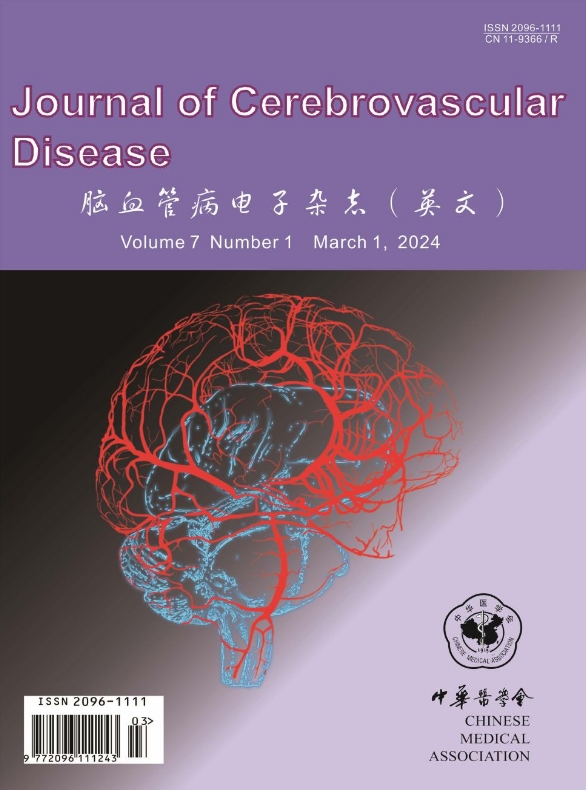
  • 《脑血管病电子杂志(英文)》(JournalofCerebrovascularDisease)(季刊),创刊于2018年,由国家卫生健康委员会主管,中华医学会主办浙大一院承办,中华医学电子音像出版社出版的全英文医学期刊,郑树森院士担任主编,杨云梅教授担任执行主编。旨在贯彻理论与实践、普及与创新、基础与临床相结合的学术准则,反映国内外脑血管病领域临床及基础科研工作的新成果、新进展、新经验,构筑起自由的学术交流舞台,提倡学术争鸣,促进跨学科的学术交流,推动医学科技的发展。设有指南与共识、述评、论著、综述、病例报告、临床图像等栏目。

  • 基本信息

  • 期刊名称:脑血管病电子杂志(英文)(Journal of Cerebrovascular Disease)
  • 主管单位:国家卫生健康委员会
  • 主办单位:中华医学会
  • 国内刊号:CN 11-9366/R
  • 国际刊号:ISSN 2096-1111
  • 出刊日期:
    期刊定价:
  • 邮发代码:
  • 所在省区:浙江
    邮政编码:
  • 联系地址:

  • 投稿信息

  • 学科分类:神经|精神病学
    版面费用:待核实
  • 字数要求:0
    查重要求:-
  • 复合因子:0
    综合因子:0
  • 审  稿 费:待核实
    稿费:待核实
  • 本刊可发:
  • 特殊属性:外文期刊

  • 联系方式

  • 投稿网址:https://mc03.manuscriptcentral.com/jcvd
  • 官网网址:http://www.jcvdcn.com/
  • 电话传真:0571-87236467(官网电话)
  • 电子邮箱:jcvdcn@163.com(官网邮箱)
    jcvdcn@hotmail.com(维普信息)
  • 微信公众号:

审稿时间:暂无参考数据,审稿时间不确定!

投稿难度:网友分享,仅供参考

见刊周期:-

温馨提示以上只是参考信息,实际情况会根据投稿主题、稿件质量和数量、审稿流程有所差异。想获得更准确信息请联系期刊的编辑部进行咨询。

欢迎点评!让信息更透明,使投稿更轻松!
    • 审稿时间:
      是否录用:
    • 发表排期:
      查重要求:
    • 有无课题:
      有无回复:
    • 我的学历:
      我的职称:
    • 审稿费用:
      版面费用:
    • 稿       费:
      稿件字数:
    • 投稿难度:
    • 该刊可发:
    • 投稿主题:
匿名: 验证码: 点击切换验证码
    • 1、投稿方式:在线投稿。

      2、官网网址:http://www.jcvdcn.com/(打不开)

      3、承办单位官网:

      https://www.zy91.com/research/magazine/97/54

      4、投稿系统:

      https://mc03.manuscriptcentral.com/jcvd

      5、官网邮箱:jcvdcn@163.com

       邮箱:jcvdcn@hotmail.com(维普信息)

      6、官网电话:0571-87236467

      7、出刊日期:季刊,一年出版4期。

      2025年5月30日星期五

      《脑血管病电子杂志(英文)》杂志简介

      【承办单位官网信息】

      2018年创刊,季刊。是一本由国家卫健委主管,中华医学会主办,浙大一院承办,中华医学电子音像出版社出版的全英文医学期刊,郑树森院士担任主编,杨云梅教授担任执行主编。旨在贯彻理论与实践、普及与创新、基础与临床相结合的学术准则,反映国内外脑血管病领域临床及基础科研工作的新成果、新进展、新经验,构筑起自由的学术交流舞台,提倡学术争鸣,促进跨学科的学术交流,推动医学科技的发展。设有指南与共识、述评、论著、综述、病例报告、临床图像等栏目。

      Instructions for Authors

      【官网信息】

      Scope

      Journal

      of Cerebrovascular Disease welcomes original research articles, review

      articles, editorials, and others in the field of medicine, especially

      the cerebrovascular disease, from any part of the world.

      Editorial process

      Manuscripts

      are reviewed by members of the international editorial board and our

      expert peer reviewers, and then either accepted for publication or

      rejected by the chief editor. Most of submissions accepted for

      publication may undergo revisions recommended by the reviewers, editors,

      or statistical advisers. A decision takes from two weeks to three

      months.

      Publication

      varies from two to six months after final acceptance. Proofs of edited

      articles and illustrations are sent to the corresponding author for

      correction and reply to any queries from editors. A sample copy of the

      journal containing the articles will be forwarded to the corresponding

      author within a few days of publication.

      Authorship

      Credit for authorship requires:

      a. Substantial contributions to the conception and design, data acquisition, analysis, and interpretation;

      b. The drafting of the article or critical revision for important intellectual content;

      c. Final approval of the version to be published;

      d.

      Agreement to be accountable for all aspects of the work in ensuring

      that questions related to the accuracy or integrity of any part of the

      article are appropriately investigated and resolved.

      Authorship credit should be based only on substantial contributions to each of the four components mentioned above.

      The

      order of naming the contributors should be based on the relative

      contribution of the contributor towards the study and writing the

      manuscript. Once it is submitted, the authorship cannot be changed

      without written consent of all the contributors. The corresponding

      author takes responsibility for the article during submission and peer

      review.

      Online submissions

      All

      manuscripts can be submitted to the official email addresses:

      jcvdcn@hotmail.com OR jcvdcn@163.com. For information on manuscript

      preparation and submission, please refer to our Instructions to Authors

      at http://jcvdcn.com/contributeManager/Instructions.do.

      If you experience any problems, please contact the editorial office by e-mail: jcvdcn@hotmail.com ORjcvdcn@163.com.

      Journal of Cerebrovascular Disease

      Generally manuscripts should be prepared according to the following:

      Title:

      Name, affiliation (institution) of the author(s), city, zip code, country, and email address of the author(s) should be

      given.

      Abstract:

      The abstract should include four sections as Objective, Methods, Results, and Conclusion and have no more than 300

      words summarizing the most important points in the article.

      Key words:

      Two or more key words/phrases for cross-indexing this article should be provided.

      Text:

      The

      main text should contain Introduction, Methods (Materials or Patients),

      Results, and Discussion. The text should comment on, but should not

      repeat, the details given in tables, figures, or captions. Any

      acknowledgments should be made at the end of the main text.

      The

      Introduction section should explain the problem which is to be

      addressed, with a definition of the hypothesis to be examined.

      In

      the Methods section, the subjects of the study and the methods employed

      in the investigation must be clearly described. For example, the

      reasons for examining the particular group of patients should be made

      clear, and reasons for exclusion of individuals from the study must be

      stated. Any group used as controls must be defined accurately. Ethical

      approval of studies and informed consent are required and should be

      described in this section.

      The

      results must be clearly expressed in simple language. Tables or similar

      diagrams can be used but must not duplicate materials already described

      in the text.

      The

      discussion must be succinct, pointing out the relevance of the work

      described in the article and its contribution to current knowledge.

      Tables

      and figures should be self-explanatory and must be numbered with Arabic

      numbers in consecutive order. Each table has a short descriptive

      heading and places explanatory matters in footnotes. The lettering on

      figures should be large enough to be clear after it has been reduced for

      printing and be consistent in size and style. Color will be accepted

      only where it is essential.

      The

      references should include only those that are important and have been

      studied fully by the authors. Authors are responsible for the accuracy

      and completeness of the cited references and for correct citation in the

      text. References follow the Vancouver format. In references, the names

      of journals should be abbreviated according to Index Medicus (List all

      authors and/or editors up to three; if more than three, list the first

      three and et al.). The references cited should be represented in the

      text by superscript numbers in the order of their appearance. The list

      of references at the end of the text should be in this numerical order

      with details and punctuation as follows:

      Article from journal

      Shang

      AD, Lu YQ. A case report of severe paraquat poisoning in an

      HIV-positive patient: an unexpected outcome and inspiration. Medicine

      (Baltimore) 2015; 94: e587.

      Ikeda

      H, Imamura H, Agawa Y, et al. Onyx extravasation during embolization of

      a brain arteriovenous malformation.Interv Neuroradiol 2017; 23:

      200-205.

      Monographic series

      Davidoff RA. Migraine: manifestations, pathogenesis, and management. Philadelphia, Pa: FA Davis; 1995.

      Contemporary Neurology Series, No. 42.

      Online journals with volume and page information

      Journal of Cerebrovascular Disease

      Simon

      JA, Hudes ES. Relationship of ascorbic acid to blood lead levels. JAMA

      1999; 281: 2289-2293. Accessed June 11, 2017.

      http://jama.ama-assn.org/cgi/content/full/281/24/2289.

      Online journals without volume and page information

      Verschuur

      EM, Steyerberg EW, Tilanus HW, et al. Nurse-led follow-up of patients

      after oesophageal or gastric cardia cancer surgery: a randomised trial.

      Br J Cancer 2008 Dec 9. doi: 10.1038/sj.bjc.6604811.

      Online website

      Morse

      SS. Factors in the emergence of infectious diseases. Emerg Infect Dis

      [serial online] 1995 Jan-Mar [cited 2017 Jun 5]; 1(1): [24 screens].

      Available from: www.cdc.gov/ncidod/eid/vol1no1/morse.htm

      Book—more than one author (list all authors if three or less, otherwise list first three followed by et al.)

      Baselt

      RC, Cravey RH. Disposition of Toxic Drugs and Chemicals in Man, 4th ed.

      Foster City, CA: Chemical Toxicology Institute; 1995.

      Chapter from a book

      Calne RY. Experimental background. In: Calne RY, Ed. Liver Transplantation, 2nd ed. London: Grune & stratton;1987: 3-7.

      Book—with editors

      Maddrey WC, Ed. Transplantation of the Liver. New York: Elsevier Science Publishing; 1998.

      Conflicts of interest

      Author(s) must declare all conflicts of interest.

      Copyright protection

      Each

      submission must be accompanied by a letter of copyright transfer signed

      by all the authors and other relevant documents including informed

      consent obtained from research subjects and research approval from the

      supervising or institutional ethics bodies.


    验证码: 点击切换验证码